Handnail Roofing walks homeowners in Montgomery County and the north Houston suburbs through roof insurance claims: the free inspection, the photos, the adjuster meeting, the scope, the supplement, and the repair or replacement afterward. Andy Hughes, the owner, does the inspection and meets the adjuster himself. There’s no public adjuster fee, we never pay or waive a deductible, and if the damage isn’t enough to claim, we tell you before you file.
A roof claim feels complicated because three parties are involved and each uses different words for the same thing. Underneath, it’s a short list of steps, and it’s your claim. Here it is in order.
How a Texas roof claim works, step by step
1. Inspection before you file
Attic first, then every slope. We photograph creased shingles, hail bruises, lifted cap and water trails inside, and tell you whether it adds up to a claim.
2. You file
You call your insurer or use their app, give the date of the storm, and get a claim number. You file, not us.
3. The adjuster visit
The insurer sends a field adjuster. We meet them on site with our photos so nothing gets missed in the twenty minutes they’re on the roof.
4. Scope and estimate
The insurer sends an itemized estimate of what they’ll pay for. We read it line by line against what the roof needs and flag what’s missing.
5. The work
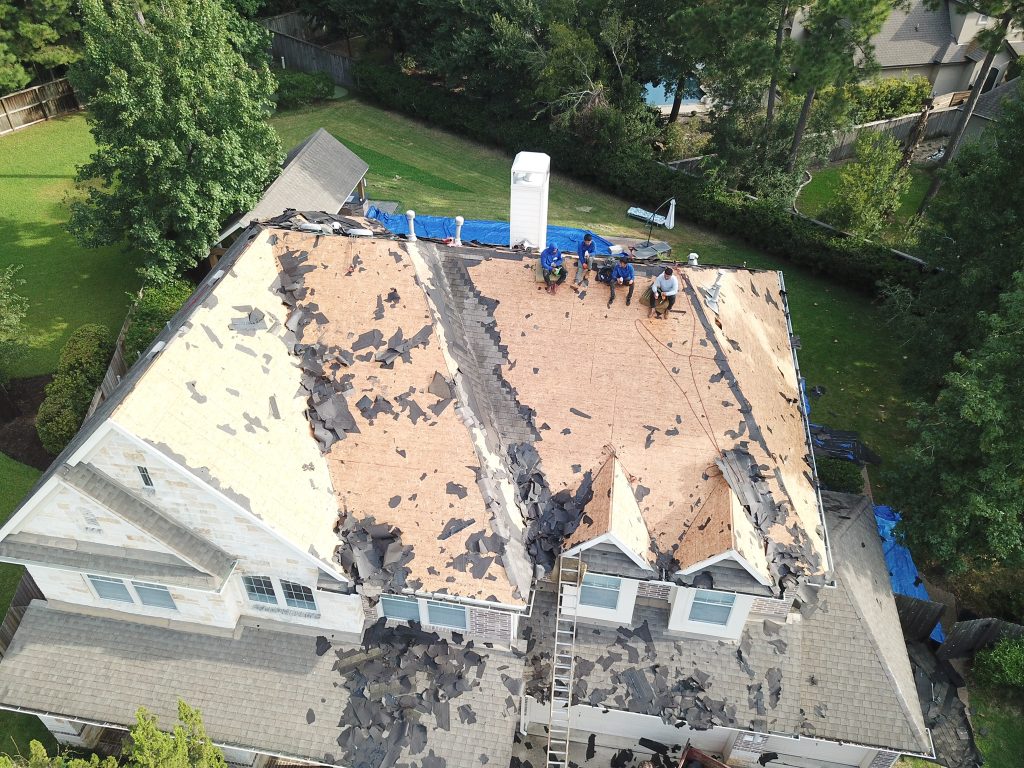
You pay your deductible, we replace or repair the roof, hand-nailed, with photos of every step. Hidden decking rot gets a photo and a price before it’s replaced.
6. The depreciation check
We send the final invoice to your insurer and they release the money they held back. It’s the step most people don’t know exists.
ACV, RCV and depreciation in plain English
Every roof claim comes down to two numbers. Replacement cost value (RCV) is what it costs to put a new roof on today. Actual cash value (ACV) is that number minus depreciation, which is the insurer’s estimate of how much life your old roof had already used up.
Say the insurer’s scope comes to $12,000, they depreciate the twelve-year-old roof by $4,000, and your deductible is $2,000. On a replacement-cost policy, the first check is $12,000 minus $4,000 minus $2,000: $6,000. You pay the $2,000 deductible to us. When the new roof is on and the invoice is sent, the insurer releases the $4,000 they held back. That held-back money is the recoverable depreciation; you end up with the full roof for the cost of your deductible.
On an actual-cash-value policy, the $4,000 is never released. You get the $6,000, and the rest is yours to cover. Many Texas insurers have moved older roofs to ACV, so read your policy before a storm, not after. Not sure which you have? Bring the declarations page to the inspection and we’ll read it with you.
Your deductible, and why no roofer can pay it
Most Texas policies now carry a percentage deductible for wind and hail, commonly 1% or 2% of the dwelling coverage. On a house insured for $350,000, a 2% deductible is $7,000, which is why “is it worth claiming” is a real question.
Paying, waiving, rebating or “absorbing” that deductible has been a crime in Texas since 2019, and your insurer can require proof you paid it before releasing the depreciation. A contractor who offers to make it disappear is either inflating the estimate to hide it or planning to cut the roof short by that amount. Walk away. Financing is available for the deductible, including 0% APR for up to 18 months for qualified buyers, subject to credit approval.
When the damage isn’t enough to claim
Some of the most useful inspections we do end with “don’t file.” A cracked pipe boot, a handful of creased tabs on the back slope, a few hail marks on soft metal and none on the shingles: that’s a repair, and most of ours run $800 to $2,000. Filing a claim for damage that costs less than your deductible gets you nothing and puts a claim on your history, possibly a denied one. So we say so, with photos, and you repair it and move on. Second-opinion calls after a door-knocker has promised a free roof usually end this way.
Supplements: when the scope misses things
The insurer’s first estimate is written by someone who was on the roof briefly, from a software price list. It’s often close and rarely complete. Common things it leaves out:
- Drip edge at the eaves and rakes, which the residential code requires on a new roof.
- Ice-and-water membrane in the valleys and around penetrations, which the shingle manufacturers call for.
- Starter strip and ridge cap priced as cut-up field shingles instead of the real products.
- Steep-slope and two-story charges, a second layer to tear off, and decking replacement where the old roof rotted through.
- Code upgrades like ventilation, if your policy carries ordinance-or-law coverage.
- Everything that isn’t shingles: dented gutters, damaged siding, a fence, the stained ceiling inside.
A supplement is the itemized list of what’s missing, with photos and the code or manufacturer requirement behind each line, sent to the adjuster for a revised scope. It’s not a way to get more money. It’s the difference between the roof they wrote and the roof you need.
Why the photos matter
An adjuster sees your roof once, for a few minutes, often weeks after the storm. Our inspection photos show every slope, every creased tab and every hail bruise, dated and labeled, plus the attic. If the scope comes back short, the photos are the supplement. If the claim goes to appraisal, the photos are the evidence. Take your own as well, before anything is cleaned up; here’s what hail and wind damage looks like.
Matching, line of sight and the half-roof problem
If only two slopes were damaged, the insurer may write two slopes. The problem is that your shingle may no longer be made, or the new color won’t match ten years of sun fade, and now the front of the house is two colors. Texas doesn’t have a matching law, so whether the whole roof gets replaced comes down to your policy wording and the case we make: product availability from the supplier, photos of the mismatch, and which slopes are visible together from the street, which is what “line of sight” means. Sometimes the honest answer really is two slopes.
How long it takes
Texas law gives the insurer 15 days to acknowledge your claim and start investigating, 15 business days after they have everything they asked for to accept or deny it in writing, and five business days after accepting to pay. After a hurricane or a countywide hail event those clocks stretch, because they can extend with written notice and every adjuster is booked. Your policy also sets a filing deadline; on many Texas policies it’s a year, so read yours. On our side, inspections are booked Mondays, Wednesdays and Fridays, the estimate goes to a portal you read on your phone, and most replacements are torn off and shingled in one day.
What we can and can’t do, and what it costs you
We can inspect and document the roof, meet the adjuster, read the scope, write the supplement, do the work and send the final invoice for the depreciation. We can’t negotiate the claim as your representative; Texas doesn’t let a roofer act as a public adjuster on a roof it’s going to repair, which is why there’s no public adjuster percentage on our invoice. We also can’t promise what the insurer will approve, and nobody honest can.
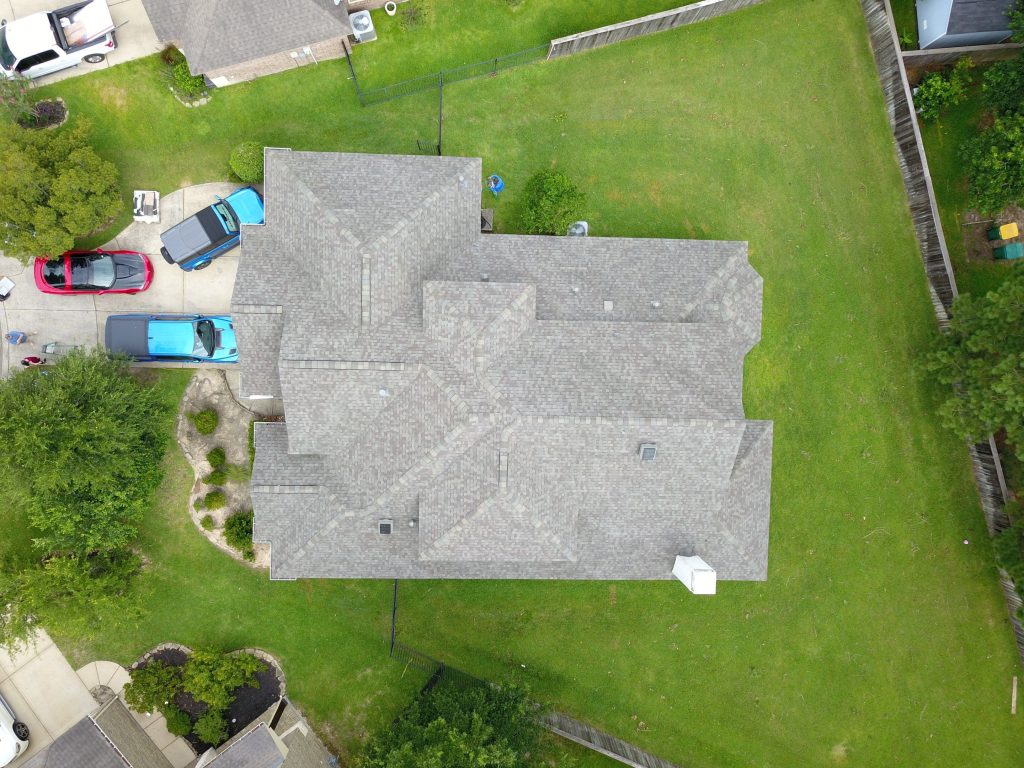
What you pay is your deductible, plus anything you add beyond the scope, like an upgraded shingle. Our price is the written estimate, itemized so it sits next to the insurer’s line by line. Full replacements in the Houston area run $400 to $600 per roofing square (100 square feet) installed in 2026, our 2026 replacements have averaged just under $400 per square, and a typical 25-square home lands between $10,000 and $15,000. Every shingle on the new roof is nailed by hand, straight, flush and inside the manufacturer’s nailing strip, so the roof that replaces a storm claim isn’t the next one.
Roof insurance claim questions
Will filing a roof claim raise my insurance rates?
It can. A claim goes on your claims history whether or not it's paid, and insurers price on that history. That's why we inspect before you file: if the damage is a repair that costs less than your deductible, filing gets you nothing.
Can a roofer pay or waive my deductible in Texas?
No. Since 2019 it has been a crime in Texas for a contractor to pay, waive, rebate or absorb an insurance deductible, and your insurer can ask for proof you paid it before releasing the depreciation. A roofer who offers to cover it is telling you how the rest of the job will go.
What is recoverable depreciation?
It's the part of the roof's value the insurer holds back until the work is done. On a replacement-cost policy the first check is the roof's depreciated value minus your deductible; once the new roof is on and the invoice is in, the insurer releases the rest. On an actual-cash-value policy there's nothing to recover.
What if the adjuster's estimate is lower than yours?
We send a supplement: photos, measurements and a line-by-line list of what the scope missed, with the code or manufacturer requirement behind each item. Most gaps close that way. If you're still stuck on the amount, most Texas policies have an appraisal clause that settles it without a lawsuit.
How long does a roof insurance claim take?
A clean claim outside storm season can go from filing to first check in a few weeks; after a hurricane or a big hail event it can be months, because every adjuster in the region is booked. Texas law puts deadlines on the insurer at each step. Once the scope is approved, most replacements are torn off and shingled in one day.
Do I have to use a contractor my insurance company recommends?
No. You choose the roofer, you sign the contract, and the insurer pays the approved scope regardless of who does the work. A preferred-vendor list is a convenience for the insurer, not a rule for you.
Where we work claims
We’re based in Spring and handle storm claims across Montgomery County and the north Houston suburbs: Conroe, The Woodlands, Spring, Montgomery, Magnolia, Tomball, Cypress, Willis, Pinehurst, Huntsville and Sugar Land. If the roof is open right now, start with emergency tarping.