Handnail Roofing repairs hurricane damage on asphalt shingle roofs in Conroe, Montgomery County and the north Houston suburbs. Andy Hughes, the owner, inspects the attic and the roof, photographs the damage the way an adjuster needs to see it, and gives you one written price. Emergency tarping is available to dry the roof in first, most most repairs run $800 to $2,000, and the inspection is free.
Conroe is a long way from the beach, and it matters less than you’d hope. Hurricane Beryl came ashore in July 2024 as a Category 1 and still had enough left in Montgomery County to strip ridge cap, crease shingles and drop pines through roofs from Lake Conroe down to Spring, two months after the May derecho had loosened a lot of them. Gulf hurricane season runs June through November.
What hurricane wind does to a shingle roof
Wind doesn’t push a roof down. It pulls it up. Fast air over the ridge and the edges creates suction, the same thing that lifts a wing, and the pull is strongest where a shingle roof is weakest: the eaves, the rakes and the ridge.
Ridge cap goes first. It’s the highest point on the house, and each cap is held by two nails and a strip of sealant that has spent years between a 140°F attic and the Texas sun. Once a few caps let go, the peak is open.
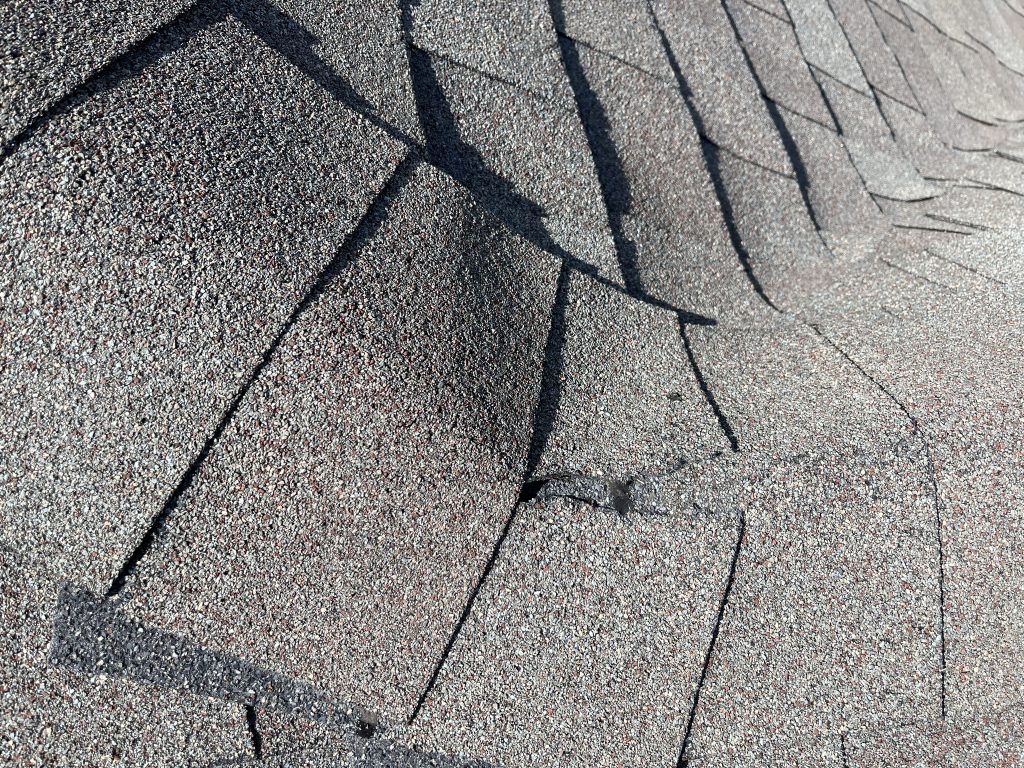
Then the tabs crease. A gust gets under a shingle whose seal strip has let go, folds it back over itself and drops it. From the driveway it looks fine afterward. It isn’t: the mat is broken along the fold, and a creased shingle never reseals.
Then the eaves peel. Wind gets under the starter course at the bottom edge, the first rows lift like pages in a book, the underlayment tears, and you’re looking at bare decking in a hurricane rain.
Then the trees. Montgomery County pines are tall, top-heavy and standing in ground the rain just turned to soup. When one goes over it doesn’t stop at the shingles, and you need emergency tarping before anything else.
Signs of hurricane damage on your roof
Missing or lifted ridge cap
Caps in the yard, a bare line along the peak, or caps standing up at one end. The first thing the wind takes, and it leaks straight in.
Creased or flipped tabs
A horizontal line across a shingle, tabs curled at the bottom, or shingles folded back over the row above. Each one gets replaced, not glued.
Exposed underlayment or decking
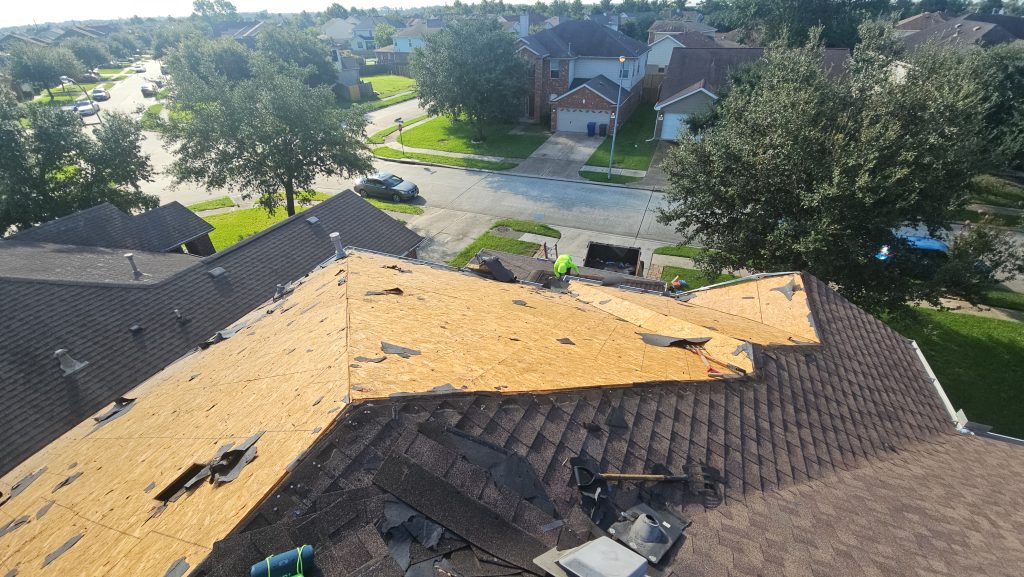
Felt showing, or bare plywood. The roof is open. Photograph it, tarp it, then call your insurer.
Limb and tree damage
Punctures, decking that sags, a branch resting on the slope. A limb that only scraped the roof usually took the granules with it.
Water through vents and soffits
Hurricane rain moves sideways. It gets in through turbines, open box vents and soffit panels the wind pulled loose.
Bent drip edge and packed gutters
Drip edge pried up at the rakes, gutters hanging or full of granules. It’s where the next storm gets in.
Don’t climb up to look; that’s what the free inspection is for. If hail came with the wind, we document both; see hail and wind damage.
Getting a roof ready before June
Most hurricane damage starts as something small that was already wrong: a seal strip that let go two summers ago, a cap with one nail, a cracked pipe boot. The wind finishes the job. Prep means finding those things in April, when they’re a repair, instead of August, when they’re a ceiling.
- Inspect, attic first. Daylight at the ridge and water trails on the rafters tell us what’s already open. Then we walk the roof and lift tabs by hand to find the ones that have lost their seal.
- Seal what’s loose. Lifted tabs get roof cement under each one. Loose caps get re-nailed and sealed. Cracked boots get replaced.
- Reinforce the edges and the ridge. On a repair, we make sure the drip edge is tight and the starter course is bonded at the eaves and rakes. On a replacement, starter runs along the rakes too, every shingle gets six nails instead of four, and every nail is set by hand inside the strip the manufacturer marks. Here’s why that pattern matters.
- Sort out the ventilation. Turbines and open box vents take in sideways rain; a ridge vent with an external baffle sheds it. Loose soffit panels let wind into the attic from below, which helps the roof lift. More on roof ventilation.
- Trim, clean, photograph. Cut back limbs, clear the gutters, and take a picture of every slope while it’s in good shape. Those are your before photos.
Inspections are free, booked Mondays, Wednesdays and Fridays. Book one in the spring.
The days after a hurricane
Stay off the roof. Wet shingles, soft decking, lines down where you can’t see them. Look from the ground and the attic, and stop there.
Photograph before you clean up. Shingles in the yard, the limb on the roof, the ceiling stain, the wet insulation. Your phone dates them. A claim with pictures moves faster than one with a description.
Stop the water. Your policy expects you to keep the damage from getting worse, and a tarp is how. Keep the invoice; most policies treat reasonable emergency work as part of the claim.
Call your insurer, and get an inspection. Texas law gives an insurer 15 days to acknowledge a claim, and after a hurricane every adjuster in the state is booked out. The wait is shorter when the damage is already documented the way they need it. If it’s a few caps and a boot that cost less than your deductible, we’ll say so before you file. Here’s how the claim process works.
Don’t decide on the driveway. Nobody needs to sign a contract the week of the storm.
About the roofers who show up after a storm
A week after Beryl, every corner from Loop 336 out to FM 1097 had a yard sign on it and a lot of trucks had out-of-state plates. Crews follow the track, knock doors for a few months, and leave before the first repair fails. Before you open the door:
- Offering to pay, waive or “absorb” your deductible has been a crime in Texas since 2019. A roofer who opens with that is telling you how they’ll handle the rest of the job.
- Texas doesn’t license roofing contractors. Anyone with a ladder and a magnet sign is a roofer here.
- Ask where their shop is. Ours is at 25031 Aughton Dr in Spring, twenty minutes down I-45, and our work is on real streets in Conroe, The Woodlands and Spring. Ask who goes on the roof; with us it’s our own crew.
- Don’t sign a contingency agreement or an assignment of your claim, and don’t pay a deposit for work that hasn’t been scoped in writing.
What hurricane roof repairs cost
Most of our repairs land between $800 and $2,000; small fixes start under $500 and a job with rotted decking on more than one slope can reach $4,500. A run of ridge cap or a patch of creased shingles is at the small end; a limb through the decking, with new plywood and shingles woven back in, is at the big end. If we find more rot once the roof is open, you get a picture and a price before it’s replaced.
When a roof has creased tabs on every slope, the honest answer is usually a replacement. Full replacements in the Houston area run $400 to $600 per roofing square (100 square feet) installed in 2026; our 2026 replacements have averaged just under $400 per square, so a typical 25-square home lands between $10,000 and $15,000. On a claim you pay your deductible and the insurer pays the rest of the approved scope. Financing is available, including 0% APR for up to 18 months for qualified buyers, subject to credit approval.
Why hand-nailed roofs hold in a hurricane
A shingle stays on in high wind when the nails are in the right place and the seal strip is bonded to the shingle below. A nail gun set hot blows through the mat; set cold, it leaves the nail proud; and a nail above the strip holds one shingle instead of two. We set every nail by hand, straight and flush, inside the line the manufacturer prints. It’s the difference between a roof that rides out a Category 1 and one that ends up in the neighbor’s pool. The longer version is here.
Hurricane roof damage questions
How do I know my roof has hurricane damage if nothing is leaking yet?
Creased shingles and missing ridge cap usually don't leak on day one; they leak in the next heavy rain, after the adjusters have gone home. Look from the ground for caps in the yard, a bare line along the peak, and tabs that sit up at the bottom edge. Then get a free inspection; we check the attic first and send photos either way.
How long do I have to file a hurricane roof claim in Texas?
Your policy sets the deadline, and on many Texas policies it's one year from the date of the storm; read yours rather than guessing. Don't wait anywhere near that long, because damage is easier to tie to a named storm in the first few weeks. Once you file, Texas law gives the insurer 15 days to acknowledge the claim.
Can you repair hurricane damage without an insurance claim?
Yes. Most of our most repairs run $800 to $2,000, and with the percentage deductibles common on Texas policies now, a small repair can cost less than your deductible. We tell you which side of that line your roof is on before you call your insurer.
What should I do when a roofer knocks on my door after the storm?
Take the card and don't sign anything. Anyone who offers to cover your deductible is offering to break Texas law, and Texas doesn't license roofers, so a truck and a yard sign prove nothing. Ask where their shop is, who does the work, and for a written, itemized estimate.
Will you tarp the roof before the adjuster comes out?
Yes. We photograph the damage first so nothing gets covered up before it's documented, then fasten the tarp to battens over the ridge so it stays put. Keep the invoice; emergency dry-in is normally part of the claim.
Where we work after a storm
We’re based in Spring and cover Montgomery County and the north Houston suburbs: Conroe, The Woodlands, Montgomery, Willis, Spring, Magnolia, Tomball, Cypress, Pinehurst, Huntsville and Sugar Land. For straight-line wind and derecho damage, see storm damage roof repair.