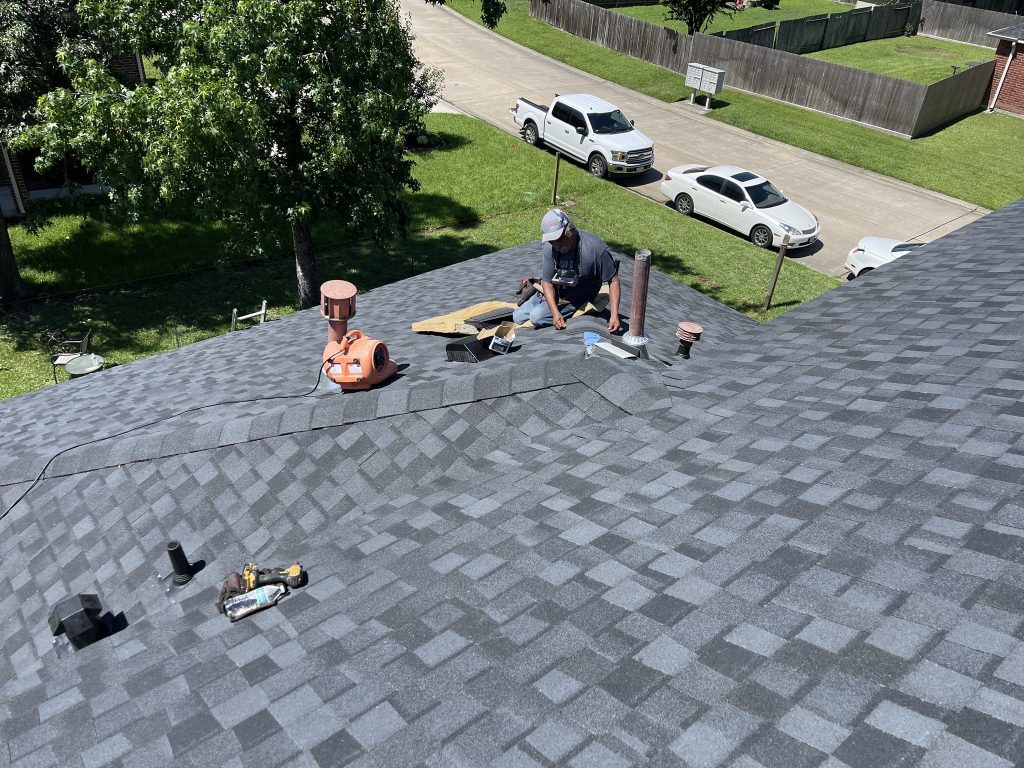
Handnail Roofing repairs storm-damaged shingle roofs across Montgomery County and north Houston: The Woodlands, Conroe, Spring, Magnolia, Tomball and the towns between. Emergency tarping to stop the water, a free inspection with photos, help with the insurance claim when the damage qualifies, and a straight answer when it doesn’t. Most storm repairs cost between $800 and $2,000 and are done in a day.
After the May 2024 derecho and Hurricane Beryl two months later, a lot of roofs around here “looked fine” from the driveway and weren’t. Lifted tabs, stripped ridge cap and cracked boots don’t drip until the next heavy rain, and by then the neighborhood has been through three rounds of door-knockers. This page is what we tell friends after a storm.
What storm damage looks like from the ground, and from the roof

From the ground: shingle pieces or whole tabs in the yard, tabs flapping in the wind, ridge cap missing along the peak, dents in the gutters, downspouts and vent caps, a pile of granules at the downspout, limbs on the roof, and a ceiling stain after the next rain. Those are worth a call.
From the roof: creased tabs, where a shingle folded back and left a line across it; seal strips broken so the tabs lift by hand; shingles torn or gone; hail bruises, soft dark spots where the granules are knocked off; cracked pipe boots; bent flashing; punctures under limbs; exposed nails where a cap shingle blew off. Half of this you can’t see from a ladder. That’s why the inspection is free and includes photos.
The first 48 hours after a storm
Stop the water
If it’s leaking, get it tarped. A dried-in roof stops the drywall, insulation and flooring damage that costs more than the roof repair. We do emergency tarping; call and say water is coming in.
Photograph everything
The yard debris, the ground view of every side of the house, every stain and drip inside, with the date. Adjusters trust dated photos from the day of the storm more than anything a contractor says a month later.
Sign nothing at the door
Out-of-town crews follow the weather. A contract signed on the porch can assign your claim to them. In Texas it’s also illegal for a roofer to waive or pay your deductible, so anyone offering to is telling you how they do business.
Get your own inspection first
Before you call the insurance company, know what’s up there. We chalk the hits, photograph every slope and tell you if it’s a claim, a repair, or nothing.
Keep the receipts
Tarping and emergency repairs are usually part of the claim when there is one. Keep every receipt and photo together.
Check the claim deadline
Most policies put a time limit on reporting storm damage. Hail that doesn’t leak for two years can miss it. Read the policy or ask your agent for the number.
How a storm damage insurance claim works
Here’s the sequence, without the drama. We inspect and document the damage. You call your carrier and open the claim. The carrier sends an adjuster; we meet them on the roof and walk them through what we found, slope by slope, so nothing gets missed because the adjuster had eleven more roofs that day. The carrier issues a scope and a first payment, less your deductible and less depreciation on a replacement-cost policy; the depreciation is released when the work is done. If the scope leaves out decking, flashing, ventilation or code items the roof needs, we write the supplement with photos. We do the work and send the final invoice so the carrier releases the held-back depreciation. Your out-of-pocket is the deductible, plus any upgrade you chose. We are not a public adjuster and we don’t charge a percentage of your claim. More on the insurance claim process, and on the specifics of hurricane roof damage.
Repair or replacement after a storm
Repair when the damage is in one place and the roof has years left: a dozen creased tabs on the back slope, a missing run of ridge cap, a limb puncture. Most of those cost between $800 and $2,000 and are done in a day; a leaking pipe vent with rotted decking under it, the most common repair we do, is usually about $1,250. Replace when the damage is spread across several slopes, when the shingles are so brittle they break the moment you lift one to slide a new one under it, or when the roof was near the end anyway and the storm finished it. A replacement in the Houston area runs $400 to $600 per roofing square installed in 2026, our 2026 replacements have averaged just under $400 per square, and a typical 25-square home lands between $10,000 and $15,000. When a claim pays for the roof, that’s the number the scope should land near. When it doesn’t, we quote it as a monthly payment. Financing is available, including 0% APR for up to 18 months for qualified buyers, subject to credit approval.
We do both, so we don’t have a reason to push either. You get the photos and the honest call. Here’s the longer repair vs. replacement guide.
What the 2024 storms taught north Houston roofs
The derecho in May 2024 was straight-line wind, not a hurricane, and it took ridge cap and whole slopes off roofs from Cypress to Conroe in a matter of minutes. Beryl in July did it again with hours of gusts from changing directions. Between them they exposed the same three weaknesses on roof after roof. Shingles nailed high, above the manufacturer’s strip, that were only held by their top layer and peeled like tape. Ridge cap nailed with short nails that never reached the deck. And tabs that had never sealed because the roof went on in cold weather and nobody hand-sealed them. None of that shows from the driveway on a calm day. Hurricane season runs June through November, so the time to find it is spring.
Why hand-nailed roofs fare better in wind
A laminated shingle has one narrow strip where a nail passes through both layers. In that strip, the nail holds the shingle and the shingle below it, and the head sits flush so the seal strip on the next course can bond over it. A nail gun on a fast crew misses high, misses low and drives crooked more often than anyone admits; every miss is a shingle held by half its thickness. We set every nail by hand, straight and flush, inside the strip, because a person is looking at each one. It’s slower. It’s also the whole point of the name on the truck. More in why hand-nailing still matters.
Storm damage questions we get after every storm
How do I know if my roof has storm damage?
From the ground: shingle pieces in the yard, tabs flapping, ridge cap missing, dents in the gutters and vent caps, or a ceiling stain after the next rain. From the roof: creased tabs, broken seal strips, bruised shingles, cracked pipe boots and punctures under limbs. Most storms don't damage a sound roof, so the free inspection is where you find out, not the driveway.
What should I do in the first 48 hours after a storm?
Photograph everything from the ground and inside, with the date on the photos. Get a tarp on any spot that's leaking so the ceiling stops taking damage. Don't sign anything with the crew that knocks on your door, and get your own roofer out for an inspection before you call the insurance company.
Should I file an insurance claim for roof storm damage?
Only if the damage is real and clearly more than your deductible, which in Texas is often a percentage of the home's value. A claim shows in your claims history whether it pays or not. We inspect first, tell you what the damage is worth, and help you file only when it makes sense.
Will you meet the insurance adjuster?
Yes. We document the damage before the visit, meet the adjuster on the roof, and go through the scope line by line afterward. If the first estimate misses decking, flashing or code items, we write the supplement. There's no public adjuster fee; it's part of the job.
Is storm damage a repair or a full replacement?
Damage in one area on a roof with life left is a repair, usually $800 to $2,000 and done in a day. Damage across several slopes, or shingles too brittle to lift without breaking, is a replacement, which insurance usually pays for when the damage qualifies. We show you the photos and tell you which we'd do on our own house.
Why do hand-nailed roofs hold up better in wind?
A shingle only stays on if the nails are in the narrow strip that catches both layers and the head sits flush so the seal strip bonds. A nail gun misses that strip high, low or crooked more often than a hand does, and every miss is a shingle the wind can peel. Hand-nailing puts every nail where the manufacturer marked it.
How fast can you tarp a leaking roof?
Call the number on this page and tell us water is coming in. Roofs that are actively leaking go to the front of the line. A tarp is a stopgap to dry the house in until the repair or the claim is sorted; the repair follows once the roof is dry.
Where we repair storm damage
We’re based in Spring and work storms across Montgomery County and the north Houston suburbs: The Woodlands, Conroe, Spring, Magnolia, Montgomery, Willis, Tomball, Cypress, Pinehurst, Huntsville and Sugar Land. After a big storm we work the hardest-hit streets first; if water is coming in, say so when you call.