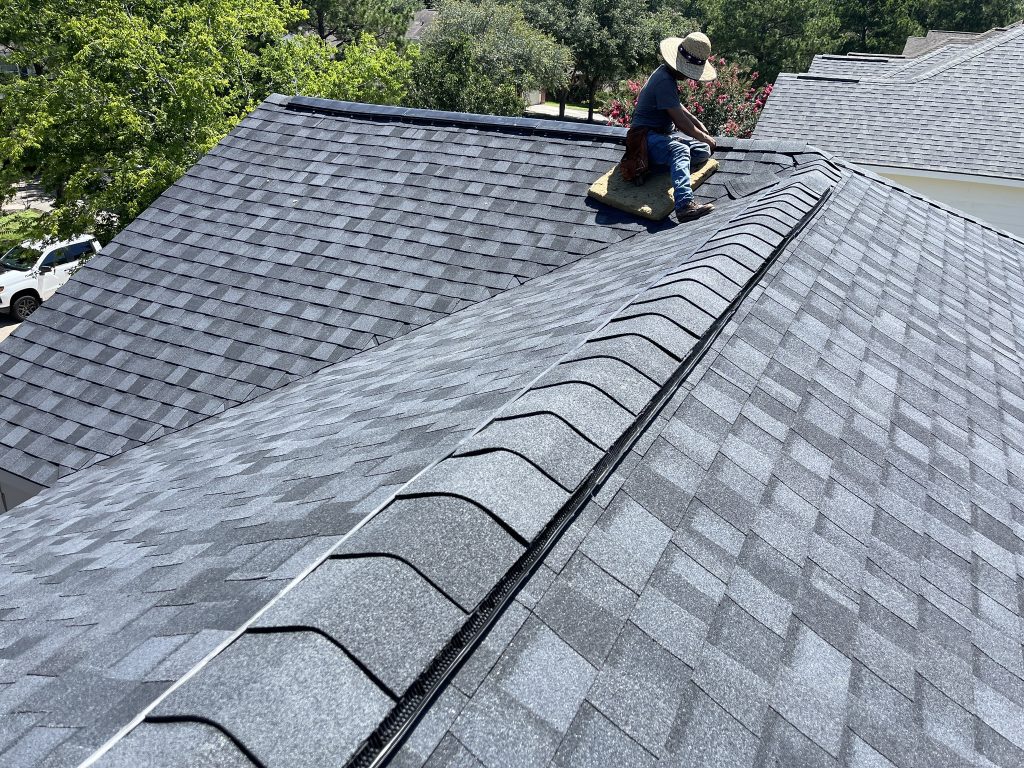
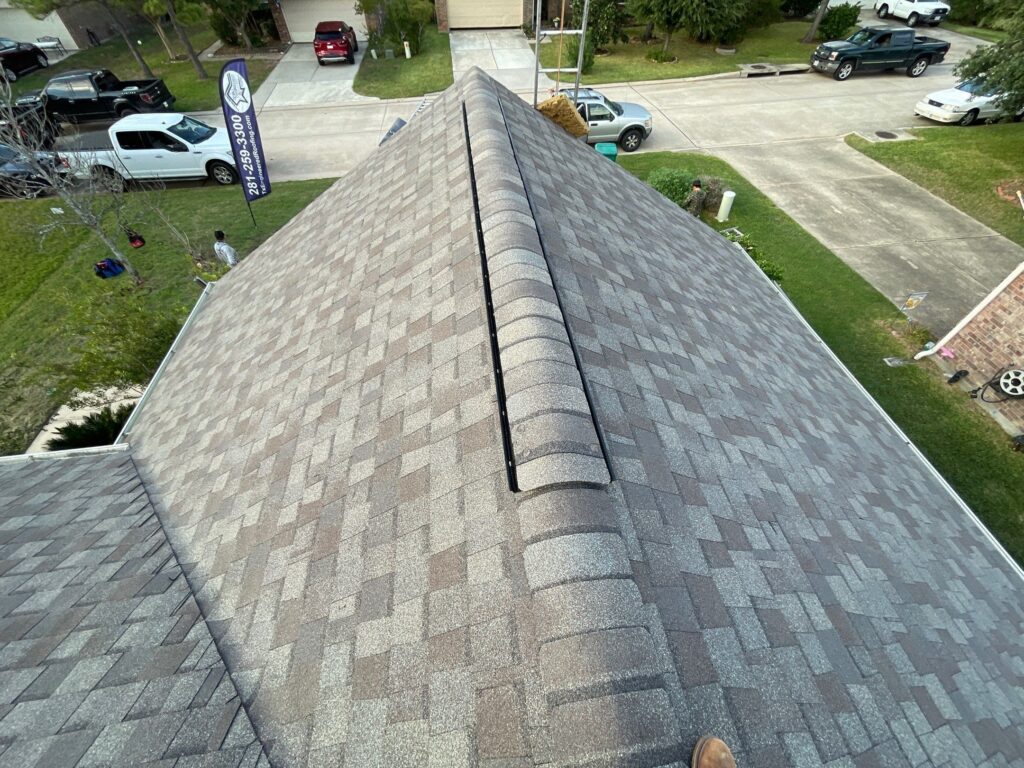
Handnail Roofing sizes and installs attic ventilation for homes in Conroe, The Woodlands, Spring and the rest of Montgomery County: soffit intake, ridge vents, baffles, and the removal of vents that work against each other. We do it during a roof replacement or as a stand-alone repair job, and the inspection is free and starts in the attic, because that’s where the problem is.
Every article about attic ventilation written north of Oklahoma is about ice dams. Forget ice dams. In Conroe the enemy is heat from above and humidity from everywhere. A roof that can’t breathe here dies young, and the air conditioner pays for it every month until then.
Why attic ventilation matters in the Conroe heat
Heat. A Houston-area attic passes 140°F on a summer afternoon. Shingles are asphalt, and asphalt baked from below as well as above loses its oils, goes brittle, sheds granules and curls years before it should. A fifteen-year-old roof over an unvented attic can look twenty-five.
Air conditioning. On most homes here the ductwork and the air handler sit in that 140-degree space. The cold air warms up in the ducts before it reaches the rooms, the system runs longer, and the ceiling radiates heat into the upstairs all evening.
Moisture. Gulf humidity, bath fans that dump into the attic instead of through the roof, and cold ductwork sweating in hot air all leave water in the attic. The result is damp insulation, mold on the underside of the decking, rusty nail tips and plywood that delaminates: rot without a leak. It’s the thing we find most often on inspections, and the thing nobody was looking for.
There’s a longer version on the blog: attic ventilation and the Conroe heat.
Intake and exhaust: how an attic is supposed to breathe
Air comes in low, at the soffits under the eaves, and goes out high, at the ridge. Hot air rises and wind across the ridge pulls it out, which draws fresh air in at the bottom. Both halves have to be there. Exhaust with no intake pulls air from wherever it can find it, usually the house, through can lights and the attic hatch. Intake with no exhaust does nothing at all. The balance should be about half and half; if it’s off, it should lean toward more intake, never more exhaust.
Types of vents, and why mixing them backfires
Soffit vents (intake)
Perforated panels or strips under the eaves. The most common problem we find is soffit vents painted shut or buried under insulation.
Ridge vent (exhaust)
A slot cut along the peak, covered by a low vent and the ridge cap. The best exhaust for a shingle roof, if it has soffit intake to feed it and a baffle to shed sideways rain.
Box vents (exhaust)
Static “turtle” vents near the ridge. They work if there are enough of them, but each one is a hole in the roof, and they move less air than a ridge vent.
Turbines (exhaust)
Spin in the wind and pull air. Fine while they spin; they seize and squeak with age, and they take in rain when a hurricane pushes it sideways.
Powered attic fans
Electric or solar. They move a lot of air, which is the problem: without enough intake they pull cooled air out of the house through the ceiling. We usually remove them.
Gable vents
Louvers in the end walls of older homes. On their own they’re fine. Combined with a ridge vent, they short-circuit it.
The mixing problem in one sentence: an exhaust vent pulls from the closest opening. Put a ridge vent on a roof that still has box vents, a gable vent or a turbine, and it pulls air in through those instead of up from the soffits. The lower attic never moves, and in a storm the box vent becomes an intake for rain. One exhaust type per attic; when we add a ridge vent, everything else comes out and gets decked over.
The 1:300 rule, explained simply
The code’s rule of thumb is one square foot of vent area for every 300 square feet of attic floor, as long as it’s split between intake at the eaves and exhaust near the ridge. If it can’t be split, the requirement doubles to 1:150, which is why balance matters.
An 1,800-square-foot attic needs 6 square feet of vent area: roughly 3 at the soffits and 3 at the ridge. The catch is “net free area.” A vent’s screens and louvers block part of the hole, so a vent is rated by the air it actually passes, not its size, and manufacturers publish that number per vent and per foot of ridge. We run the math for your attic and put the vent counts on the written estimate.
Signs your attic isn’t breathing
- The upstairs won’t cool down after mid-afternoon, and the attic still feels like an oven at nine at night.
- Shingles curling or blistering on a roof that’s under fifteen years old.
- Dark staining or mold on the underside of the decking, rusty nail tips poking through, a musty smell at the hatch.
- Soffit vents painted over, or insulation stuffed into the eaves with no baffles.
- A long ridge with no vent on it and two box vents for the whole house.
- A powered fan that runs all day and a second floor that’s hot anyway.
Any of those is a reason to book a free roof inspection. We go into the attic first, photograph what we find, and tell you whether the roof is venting or not.
What we do: during a replacement vs. a stand-alone job
During a roof replacement is the best time to fix ventilation, because the roof is open and the cost of doing it right is small. We cut the ridge slot and install ridge vent under hand-nailed cap, remove the old box vents and deck over the holes, install baffles at the eaves so insulation can’t block the soffits, confirm the soffit vents are open, and run bath fans through the roof with proper caps. Each item is a line on the estimate.
As a stand-alone job, we can cut a ridge vent into an existing roof and cap it to match, add or open up soffit vents, install baffles from inside the attic, replace a seized turbine with a static vent, remove a powered fan and deck over it, or add edge-of-roof intake vents on a house with no soffits. It’s a repair-sized job on most homes, and rotted soffit boards get replaced as part of our siding and soffit work.
Radiant barrier: worth it or not
A radiant barrier is a reflective foil facing under the decking that turns back part of the sun’s heat before it gets into the attic. In our climate it helps more than in most of the country, especially with ductwork up there. It doesn’t move any air, though, and it won’t fix a blocked soffit. The cheap time to get one is during a replacement, as foil-faced decking where old plywood is coming out anyway; stapling foil to the rafters in a finished attic is a bigger job. We’ll tell you whether it’s worth it on your house.
What ventilation work costs
Stand-alone ventilation is priced like any repair: a written, itemized number after the free inspection. Our most repairs run $800 to $2,000, and where a ventilation job lands in that range depends on how much ridge vent is going in, how many soffit vents need adding, and whether a fan or turbines are coming out.
On a replacement, ridge vent, baffles and vent removal are line items on the same estimate as the shingles. Full replacements in the Houston area run $400 to $600 per roofing square (100 square feet) installed in 2026; our 2026 replacements have averaged just under $400 per square, so a typical 25-square home lands between $10,000 and $15,000. Financing is available, including 0% APR for up to 18 months for qualified buyers, subject to credit approval. For a ballpark, try the roof cost calculator.
One more thing about the ridge. The cap over a ridge vent is the most exposed shingle on the house, and we nail it by hand with the longer nails the vent calls for, straight and flush, so the first north wind of the fall doesn’t peel it back.
Attic ventilation questions
How hot does an attic get in Conroe?
Past 140 degrees on a summer afternoon, and it stays hot into the evening because the decking holds the heat. Your air conditioning ducts usually run through that space, and the shingles are being heated from below as well as above. Ventilation can't make the attic cool, but it keeps it from becoming an oven.
Do I need a ridge vent if I already have box vents?
Not both. A ridge vent pulls from the nearest opening, and if that's a box vent a few feet away, the air comes through the box vent instead of up from the soffits, and the lower attic never moves. Pick one exhaust type; if we add a ridge vent, the box vents get removed and decked over.
Are powered attic fans worth it in Texas?
Usually not on a house with enough soffit intake and a ridge vent. Without enough intake, a fan pulls conditioned air out of the house through every gap in the ceiling, and it can pull rain in through a ridge vent. If you keep one, it needs plenty of intake.
Can you add ventilation without replacing the roof?
Yes. A ridge vent can be cut into an existing roof and capped to match, soffit vents can be added or opened up, baffles go in from the attic, and a seized turbine or a dead fan can come out and be decked over. It's priced like any repair.
Will better ventilation lower my electric bill?
Some, and we won't put a number on it because it depends on your ductwork, insulation and how the house is used. The bigger, more certain wins are shingle life, a dry attic, and a second floor that stops running hotter than the first.
Does my shingle warranty require attic ventilation?
Most manufacturer warranties require ventilation that meets the code minimum, and an attic that can't breathe is a common reason a heat-related claim gets denied. That's one more reason we size the vents on every replacement and put the numbers on the estimate.
Where we work
We’re based in Spring and cover Montgomery County and the north Houston suburbs: Conroe, The Woodlands, Spring, Montgomery, Magnolia, Tomball, Cypress, Willis, Pinehurst, Huntsville and Sugar Land. Not sure if you’re in range? Call and ask.