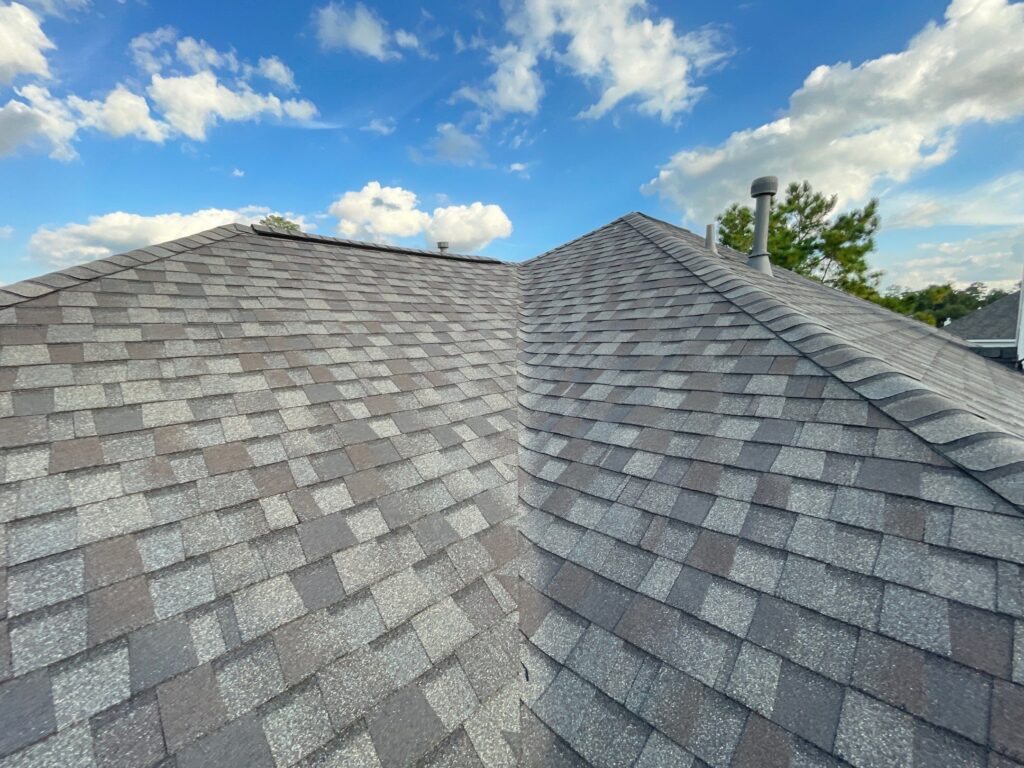

Handnail Roofing inspects and repairs hail and wind damage on shingle roofs in Conroe, The Woodlands, Magnolia and across Montgomery County. Andy Hughes, the owner, chalks a test square on every slope, photographs each bruise and crease the way adjusters count them, and tells you honestly whether it adds up to a claim. The inspection is free. Most repairs run $800 to $2,000; replacements in the Houston area run $400 to $600 per square installed, and our 2026 jobs have averaged just under $400 per square.
Conroe sits in the hail belt north of Houston. Most springs bring at least one storm with stones big enough to mark a roof, and most of those storms don’t do enough to claim. Some do, and the damage won’t leak for two years. Telling the two apart is technical, so this is the technical page. The what-to-do-after-a-storm guide is on the storm damage repair page.
Hail bruising vs. blistering: real hail damage or a bad shingle
A hail bruise is a strike that knocked the granules off in a rough circle and crushed the fiberglass mat underneath. Press it with a thumb and it gives, like a bruise on an apple. Bruises land at random, are heaviest on the slopes that faced the storm, and match dents in the soft metals nearby. Fresh ones look black and shiny because the asphalt is exposed; old ones fade to gray.
Blistering looks similar from three feet away and isn’t hail. Blisters come from moisture trapped in the shingle at the factory or from an attic that runs too hot; they’re small pits with a hard bottom, often with a raised rim of granules, and they show up on every slope no matter which way the storm came from. Adjusters know the difference and so do we, along with scuffs from foot traffic, scrapes from a limb and nail pops. A roof covered in blisters is a heat and ventilation problem, not a claim, and we’ll say so.
How adjusters count hail hits
The adjuster chalks a square, 10 feet by 10 feet, on each slope and circles every bruise inside it. Many carriers treat eight or more hits in a square as a slope that gets replaced, though the number moves from company to company and some count the whole roof rather than slope by slope. The adjuster also checks the soft metals: gutters, downspouts, roof vents, the top of the AC unit, aluminum trim. Dents there confirm the hail was big enough and show which direction it came from.
We chalk our own squares before the adjuster arrives, photograph each one with the count written on the roof, and go through it with them. That’s the point of meeting the adjuster: making sure every slope gets counted, not just the two that were easy to reach. If the first scope misses a slope, decking, flashing or code items, we write the supplement with those photos. No public adjuster fees. The full claim walkthrough is on the insurance claims page.
Wind damage: creased tabs, lifted shingles and broken seals
Creased tabs
The wind lifted the tab, folded it back and let it drop. It looks fine from the ground; up close there’s a horizontal line where the mat broke. It will lift again in the next gust, so it gets replaced, and adjusters generally pay for creased shingles.
Lifted but not creased
The seal strip let go but the mat didn’t break. These can often be hand-sealed with roofing cement and pressed back down. If the shingle is old and brittle, it breaks when you try, and then it’s a replacement.
Missing tabs and cap
Ridge cap, the first courses above the eaves and the rakes take the most wind. Missing pieces expose nails and underlayment, and they leak faster than any other wind damage.
High-nailed shingles
Nails driven above the manufacturer’s strip hold only the top layer of a laminated shingle. In the May 2024 derecho and Hurricane Beryl, those roofs shed whole slopes while roofs next door lost nothing. The storm exposed an installation problem.
Unsealed tabs
Shingles installed in cool weather that never got hot enough to bond. Years later they lift in a moderate wind. We hand-seal them on a repair and check the seal on every course of our own installs.
Puncture and impact
Limbs, debris, a patio umbrella. Small, local, usually a two-hour repair, but they leak immediately, so they go first.
Wind resistance comes down to the nails. A hand-set nail is straight, flush and inside the manufacturer’s strip every time, so it holds both layers of the shingle and lets the seal strip bond over it. A nail gun misses more than anyone admits, and every miss is a shingle the wind can peel. Here’s the longer version.
Class 3 and Class 4 impact-rated shingles
Impact ratings come from a test where steel balls are dropped on a shingle from height. Class 3 means the shingle took a 1.75-inch ball without cracking; Class 4 means a 2-inch ball, which is about the size of the hail that does real damage around Conroe. Most Class 4 shingles use a rubberized asphalt that flexes on impact instead of fracturing. Common Class 4 options are GAF Timberline AS II, CertainTeed Landmark ClimateFlex and Owens Corning Duration FLEX, and we’ll show you the spec sheet for whichever brand you prefer. Two honest notes. The rating is about cracking, not looks: a Class 4 roof can still lose granules in a big storm, and some carriers that discount the premium for Class 4 add a cosmetic-damage exclusion, so ask your agent. And a Class 4 shingle costs more per square; we show that difference in dollars and as a monthly payment before you decide. The rest of the shingle decision is on the roof replacement page.
Why hail damage shows up as leaks years later
A bruise doesn’t leak on the day of the storm. The granules are gone from that spot and the mat is fractured, but the asphalt is still sealing. Then the sun goes to work. Granules are the shingle’s only protection from ultraviolet light, and bare asphalt in a Conroe attic that passes 140°F in July dries out and cracks in one to three years. When the crack reaches the underlayment, water gets through at the next hard rain, and the leak shows up somewhere else entirely, because water runs down the underlayment before it drips. By then the storm is two hailstorms ago and the claim window on your policy may have closed. That’s the case for a free inspection after any hail an inch or bigger, dripping or not.
The honest “it’s not enough to claim” conversation
We have this conversation a lot. Your roof has a few bruises per square, or a dozen creased tabs on the back slope. The carrier’s threshold isn’t met, or the repair is worth less than your deductible, which on many Texas policies is a percentage of the home’s value. Filing would put a claim in your history for nothing. So we quote the repair: most run $800 to $2,000, and the most common one, a leaking pipe vent with rotted decking, is usually about $1,250. If the roof really is done, a replacement runs $400 to $600 per square installed in the Houston area in 2026, our 2026 replacements have averaged just under $400 per square, and a typical 25-square home lands between $10,000 and $15,000. Financing is available, including 0% APR for up to 18 months for qualified buyers, subject to credit approval. And if the roof is fine, it’s fine. We’d rather have that conversation than file a claim you’ll regret.
Hail and wind damage questions from Conroe homeowners
How can I tell hail damage from normal wear on my shingles?
A hail bruise is a round spot where the granules are gone and the mat underneath feels soft when you press it, scattered at random and heaviest on the slopes that faced the storm. Normal wear is even thinning across a whole slope, with granules gone along the edges and exposed lines rather than in circles. Blisters from heat look like tiny popped bubbles with a hard bottom. We chalk and photograph each one so you can see the difference yourself.
How many hail hits does it take for insurance to replace a roof?
Many carriers use eight or more bruises in a 10-by-10 foot test square on a slope as the point where that slope is replaced rather than repaired, though the number varies by company and adjuster. The adjuster chalks a square on each slope and counts. We do the same before they arrive so the two counts can be compared.
Is it worth filing a claim for wind damage on a few shingles?
Usually not. A dozen creased tabs is a repair in the $800 to $2,000 range, and if that's under your deductible the claim pays nothing and still shows in your claims history. Creased shingles do need replacing, because the fold has broken the mat and the seal, so we quote the repair and you decide.
Why is my roof leaking now from hail that hit two years ago?
A bruise knocks the granules off and fractures the fiberglass mat underneath. The bare asphalt then sits in the Texas sun, dries out and cracks through over a year or two. Once the crack reaches the underlayment, the next hard rain finds it. That delay is why we recommend an inspection after any hail an inch or bigger, even if nothing is dripping.
Are Class 4 impact-rated shingles worth it in Conroe?
For most people who plan to stay in the house, yes. Class 4 shingles are tested to take a 2-inch steel ball without cracking, they hold up far better to the hail north of Houston, and many Texas insurers discount the premium for them. Ask your agent whether the discount comes with a cosmetic-damage exclusion, and we'll quote a Class 4 next to a standard shingle so you can see the price difference.
Will you tell me if my roof doesn't have enough damage to claim?
Yes, and we do it often. If the hit count is under the carrier's threshold, or the damage is worth less than your deductible, we tell you that and quote the repair instead, or tell you the roof is fine. A four-year-old roof with a few scuffs is not a claim, whoever knocked on your door.
Hail and wind damage beyond Conroe
We’re based in Spring and inspect hail and wind damage across Montgomery County and the north Houston suburbs: Conroe, The Woodlands, Magnolia, Montgomery, Willis, Spring, Tomball, Cypress, Pinehurst, Huntsville and Sugar Land. Shorter field guide: hail roof inspections in Conroe and The Woodlands.